Retired Military Pay Dates in 2026
Military retirees and annuitants get paid on the first day of the month, unless it falls on a weekend or holiday. If so, retirees are paid on the preceding business day and annuitants are paid on the following business day.

Why trust The Military Wallet? We’re a veteran-founded resource that has helped millions make strong financial decisions.
Advertiser Disclosure: The Military Wallet and Three Creeks Media, LLC, its parent and affiliate companies, may receive compensation through advertising placements on The Military Wallet. For any rankings or lists on this site, The Military Wallet may receive compensation from the companies being ranked; however, this compensation does not affect how, where, and in what order products and companies appear in the rankings and lists. If a ranking or list has a company noted to be a “partner,” the indicated company is a corporate affiliate of The Military Wallet. No tables, rankings, or lists are fully comprehensive and do not include all companies or available products.
The Military Wallet and Three Creeks Media have partnered with CardRatings for our coverage of credit card products. The Military Wallet and CardRatings may receive a commission from card issuers. You can read more about our card rating methodology here.
Opinions, reviews, analyses & recommendations are the author’s alone and have not been reviewed, endorsed, or approved by any of these entities. For more information, please see our Advertising Policy.
American Express is an advertiser on The Military Wallet. Terms Apply to American Express benefits and offers.
Military retirees and annuitants are paid on the first day of the month, unless that day falls on a weekend or holiday. If so, retirees are paid on the preceding business day, and annuitants are paid on the following business day.
| Entitlement Month | 2026 Retiree Pay Dates | 2026 Annuitant Pay Dates |
|---|---|---|
| January | Jan. 30, 2026 | Feb. 2, 2026 |
| February | Feb. 27, 2026 | Mar. 2, 2026 |
| March | Apr. 1, 2026 | Apr. 1, 2026 |
| April | May 1, 2026 | May 1, 2026 |
| May | June 1, 2026 | June 1, 2026 |
| June | July 1, 2026 | July 1, 2026 |
| July | July 31, 2026 | Aug. 3, 2026 |
| August | Sept. 1, 2026 | Sept. 1, 2026 |
| September | Oct. 1, 2026 | Oct. 1, 2026 |
| October | Oct. 30, 2026 | Nov. 2, 2026 |
| November | Dec. 1, 2026 | Dec. 1, 2026 |
| December | Dec. 31, 2026 | Jan. 4, 2027 |
As we wrote in our article on the military pay date schedule, the first step in creating a budget is knowing how much you will be paid and when.
The good news is that military retirement and annuity pay dates are easy to remember: You usually receive your pay on the first of the month. The only exception is when the first of the month falls on a weekend or holiday. When it does, retirees are paid on the preceding business day. Annuitants, surviving spouses, or family members are paid the following business day.
Here are the military retiree pay dates for 2026. This applies to all branches of the military. You will need to check MyPay for your retiree account statement (RAS).
When Will My Retirement Pay Be Reflected in My Bank Account?
Military paychecks are generally available on the payment date. Payments may hit your bank a day or two later.
Some military-friendly banks offer military deposits a day or two earlier than the actual pay date. This is common with Navy Federal Credit Union (if you use the Active Duty Checking Account), among others. Here is the list with the NFCU pay dates.
Your Retirement May Be Reduced Depending on the Month You Retire
We recently wrote about the COLA trap, which can cost Veterans tens of thousands of dollars in retirement depending on the timing of their retirement. In summary, the COLA trap is a financial pitfall where military retirees receive a lower pension due to the timing of their retirement. This occurs because the first Cost of Living Adjustment (COLA) is calculated based on specific months, causing some retirees to receive a smaller adjustment. To avoid this, service members should retire at the end of a fiscal quarter, avoid September retirements, and consider retiring in March for the best initial COLA impact.
How To Use DFAS’s MyPay to Understand Your Retirement Pay
The Defense Finance and Accounting Service, or DFAS, handles military retirement pay. They handle all record-keeping, tracking, payments, etc. Retirees can track their pay on MyPay.
Log on to your MyPay account and view your Retiree Account Statement (RAS), a two-page document the DFAS issues that summarizes your pay, benefits, and any deductions, including allotments.
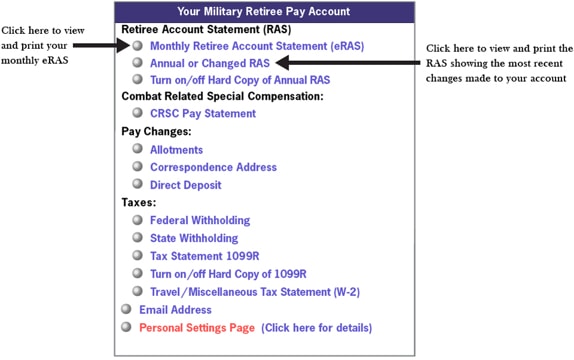
As a military retiree, you’ll receive a retiree account statement each month and an annual RAS in December. MyPay makes the previous 12 RAS statements available to you. If you want to keep a long-term record, download the RAS in PDF format.
You can provide your email address on MyPay and opt-in to receive an email reminder each month when your RAS is available.
Other ways to use MyPay: In addition to tracking and downloading your Retirement Account Statements, you can also use MyPay to download your tax forms, change any allotments you might have, and change your banking or contact information.
Your retirement pay is made in arrears, meaning you receive pay for the previous month.
How Does Your Military Pay Change in Retirement?
Your military retirement pay is based on a complex formula and depends on whether you participate in the High-3 retirement plan or are enrolled in the Blended Retirement System (BRS). Both calculate your pay using your basic pay (your final basic pay for BRS and the average of your highest 36 months of basic pay for High-3) and your time in service.
You will no longer have your basic allowance for housing (BAH), basic allowance for subsistence (BAS), or other benefits, such as incentive pay or bonuses. However, in 2021, the Department of Defense announced that military retirees would begin receiving an annual cost-of-living adjustment (COLA).
You must also consider any withholdings, such as taxes, insurance, and allotments.
The good news is that many states do not tax military retirement pay, so you may see an unexpected boost.
Here are some additional deductions from your retirement pay that you may see, depending on your situation:
- Survivor Benefit Plan (SBP) Premiums: Your SBP premium will be a maximum of 6.5% of your pay. This is deducted from your pay before taxes are calculated.
- Tricare Prime: You are still eligible for Tricare Prime until you qualify for Medicare. You can choose a single or family plan, and the premiums are subject to change annually.
- Tricare for Life: Tricare for Life is a program for those who also have Medicare. The price is based on a single or family plan and is subject to change annually.
- Retiree Dental Insurance: You can choose from several plans. The price is based on your plan, location, and number of dependents.
- Veterans Group Life Insurance: You may be eligible to continue your life insurance coverage. If you choose to do so, you can find the rates on the VGLI-Rates tables.
- Possible Withholding of VA Disability Compensation: If you are not eligible for concurrent receipt, you may see reduced retirement pay. Learn more about how VA disability compensation affects retirement pay.
- Any allotments.
You can find a full analysis of how your military pay changes when you retire. This is a great resource for planning purposes.