A Guide to the TSP Lifecycle Funds
The Thrift Savings Plan (TSP) offers a variety of investment options, including Lifecycle Funds (L Funds), designed to simplify retirement planning. This guide explains how L Funds work, their investment strategies, and whether they're the right fit for your financial goals.


Why trust The Military Wallet? We’re a veteran-founded resource that has helped millions make strong financial decisions.
Advertiser Disclosure: The Military Wallet and Three Creeks Media, LLC, its parent and affiliate companies, may receive compensation through advertising placements on The Military Wallet. For any rankings or lists on this site, The Military Wallet may receive compensation from the companies being ranked; however, this compensation does not affect how, where, and in what order products and companies appear in the rankings and lists. If a ranking or list has a company noted to be a “partner,” the indicated company is a corporate affiliate of The Military Wallet. No tables, rankings, or lists are fully comprehensive and do not include all companies or available products.
The Military Wallet and Three Creeks Media have partnered with CardRatings for our coverage of credit card products. The Military Wallet and CardRatings may receive a commission from card issuers. You can read more about our card rating methodology here.
Opinions, reviews, analyses & recommendations are the author’s alone and have not been reviewed, endorsed, or approved by any of these entities. For more information, please see our Advertising Policy.
American Express is an advertiser on The Military Wallet. Terms Apply to American Express benefits and offers.
When you sign up for the Thrift Savings Plan (TSP), you can choose from six fund options. Five are based on index funds, and the last is a government securities fund. Index funds allow investors to buy a bundle of stocks that track a single market sector.
Lifecycle Funds, also called L Funds, are structured differently. This group of 11 fund options uniquely mixes portions of the other five funds based on a retirement plan end date.
L Funds became the default option for TSP participants in 2015 and remain the most popular option today. As of October 2025, L Funds accounted for more than $270 billion, roughly a quarter of all TSP assets.
In other words, if you think you might retire in 2038, you might be placed in the 2040 L Fund. However, you can decide which Lifecycle Fund to enroll in.
For example, while the TSP G Fund tracks short-term US Treasuries exclusively, L Funds diversify participant accounts among the G, F, C, S, and I Funds, using professionally determined investment mixes tailored to different time horizons.
Many people manage their own asset allocation and choose which investments to hold. Asset allocation simply means combining different percentages of the other five funds to create L Funds with varying risk levels.
Funds with a target date further into the future are weighted more heavily toward risk than funds with a shorter maturity date.
Lifecycle Funds take an alternative approach with allocation based on investment modeling by a well-respected consulting group. Rather than a participant making decisions, investing in an L Fund means transferring that critical analysis to industry professionals.
L Funds automatically adjust over time to lower the portfolio risk as you get closer to the target date. Because experts strategically determine this allocation, it’s best to invest in an L Fund and not also invest in other TSP funds. Doing so will screw up your properly balanced asset allocation.
As a result, you’ll take on too much risk for the return you want, or you won’t make as much as you should for the risk you’re taking. You can adjust your allocations manually to keep your portfolio properly balanced, rather than leaving it to a professional to handle automatically.
When you have money in other accounts outside your TSP, you also risk unbalancing your risk. This could alter your long-term financial planning goals and indirectly impact your L Fund or TSP allocation efforts.
In such cases, meeting with a financial planner is often best to discuss your options and investment allocation goals.
Investment Objectives of TSP Funds
To fully understand how L Funds work, start with a brief overview of the other TSP funds. Those fund choices include:
G Fund – Short-term U.S. Treasuries specially issued to the TSP. The U.S. Government guarantees payment of principal and interest.
Thus, there is no credit risk. The G Fund offers the opportunity to earn interest rates similar to those of long-term Government securities, with no risk of loss of principal and very little volatility in earnings.
F Fund – U.S. Corporate Bonds that seek to match the performance of the Bloomberg U.S. Aggregate Bond Index, a broad index representing the U.S. bond market.
C Fund – Large U.S. Companies (S&P 500) that seek to match the performance of the Standard and Poor’s 500 (S&P 500) Index, a broad market index comprised of stocks of 500 large to medium-sized U.S. companies.
S Fund – Small U.S. Companies that seeks to match the performance of the Dow Jones U.S. Total Stock Market Index, a broad market index comprised of stocks of U.S. companies not included in the S&P 500 Index.
I Fund – An international fund that seeks to match the performance of the MSCI ACWI IMI ex USA ex China ex Hong Kong Index.
You can also visit the TSP home page and click on Fund Options for more detailed fund objectives and information.
“One of the worst things you could do is put it all into the G Fund, which is very stable, but you’re not gonna make money. You might not even keep up with inflation. So if you put it all in G, you’re gonna look at it and say, ‘Didn’t lose any money, I’m good,’ but you’re not keeping up with your spending power…Conversely, if you put it all into the C Fund or the S Fund, you’re bringing on extra volatility, and you might have swings that are higher or lower than you anticipate. And some people have a hard time dealing with that — to look at their balance and say, ‘My gosh, it used to be $10,000, now it’s $7,000. What happened? I’m scared, I’m gonna pull it all out.’ That’s the worst thing you can do.”

How the L Funds Work
You can choose from 11 L Funds, each with a different target maturity date. Ten of those funds have target dates in five-year time frames ranging from 2030 to 2075. The exception is the L Income Fund, explained in greater detail below.
These funds’ asset allocations vary by risk level. For example, the L Fund maturing in 2030 is more conservatively weighted than the L Fund maturing in 2060.
The thinking is that as a fund’s end date approaches, the emphasis shifts from maximizing growth and returns to protecting and preserving gains.
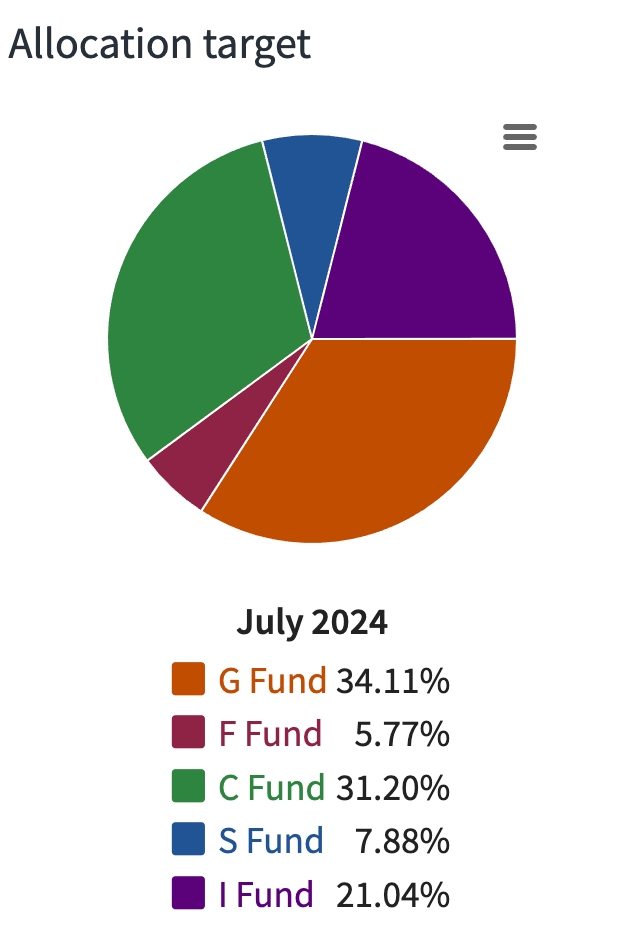
So, an L Fund with a 2030 target date will have a higher percentage mix of G and C Funds, which offer lower, more conservative returns through stable US Treasuries and large US companies. The allocation mix for the 2030 L Fund at the end of 2023 looked like this.
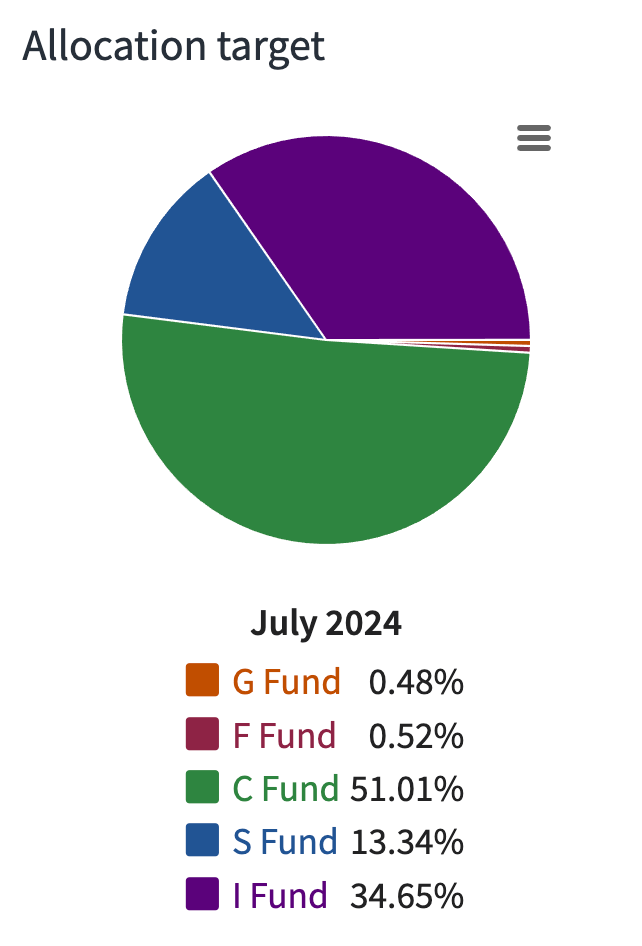
This contrasts with an L Fund with a 2060 date, which has a greater weighting in C and I Funds, representing higher risk but a higher anticipated return to grow a participant’s TSP account.
They were designed to let you invest your entire portfolio in a single L Fund and get the best expected return for the level of risk appropriate for you.
Every three months, the target allocations of all the L Funds (except the L Income Fund) are automatically adjusted, gradually shifting them from higher risk and reward to lower risk and reward as they approach their target dates.
These allocations do not change even if individual funds don’t perform as well as others. However, each day, to maintain the L Fund’s target allocation, administrators rebalance the L Funds by buying and selling individual funds so percentages return to what they were at the beginning of the day.
This active approach means that fund managers buy low and sell high at the end of each trading day to maximize returns.
The L Income Fund
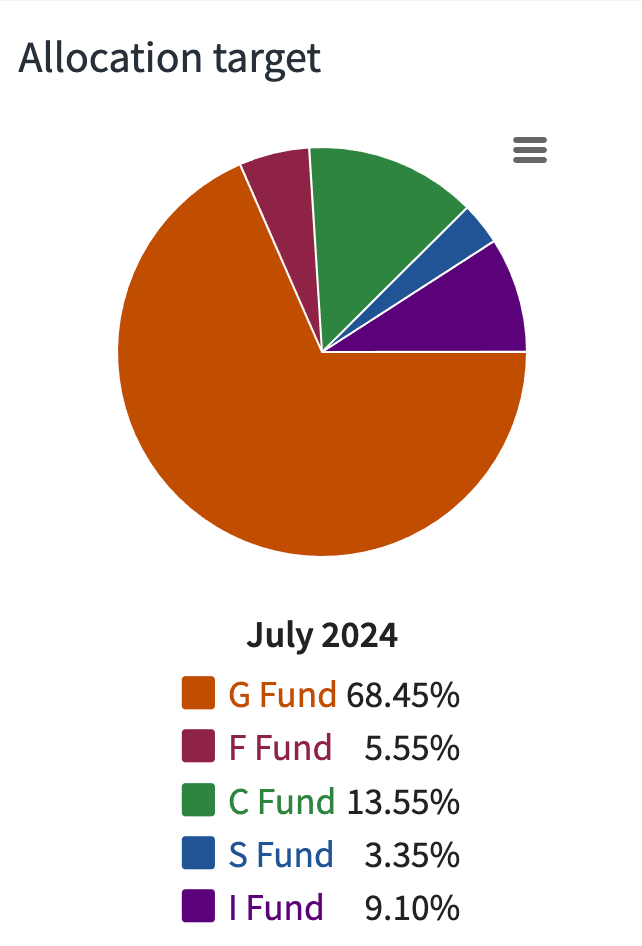
The L Income Fund is best suited for participants born before 1960 who are currently making withdrawals from their TSP account as part of their retirement income. For this reason, the L Income Fund is the most conservative of all L Funds.
It focuses heavily on preserving capital and minimizing risk, although it is still subject to losses and gains.
This is why it is weighted more heavily toward G and F Funds and less toward the riskier C, S, and I Funds. This strategy also focuses on reducing inflation’s effect on a participant’s purchasing power.
When an L Fund reaches its target date, it ceases to exist, and any money in it becomes part of the L Income Fund. For example, when the L 2025 Fund matured in June 2025 and was folded into the L Income Fund, the same thing will happen to the L 2030 Fund when it reaches its target date.
Should I Invest in a Lifestyle Fund?
It depends. L Funds are best for people who are new to investing or not confident in their investing knowledge and want assistance in a well-thought-out long-term investment strategy.
While it is less tailored than a fully individualized investment approach, if you agree with the risk level and financial goals of a target date strategy, it is a hassle-free, relatively conservative approach that can work well for you.
The happy balance is going with one of these L Funds. It’s automatically diversified. You have a little bit of government, a little bit of corporate bonds, you have large U.S. companies, small U.S. companies, international, and as you get closer to retirement, it automatically adjusts for you. It’s kind of like the easy button for investment portfolios.”
Learn More About the TSP and Lifestyle Funds
This article is a good introduction to L Funds, but as with any investment, you should do as much homework as possible until you feel comfortable making a choice that best fits your situation.
Here are some other resources we’ve created to help you better understand your investing options.
Why the TSP Has Enough Diversification for Any Investor
The Thrift Savings Plan Mutual Fund Window
Thrift Savings Plan Contribution Limits
How to Manage Your Thrift Savings Plan Account
Thrift Savings Plan Annuity Calculator