Power of Attorney – What Military Members Need to Know
What military members need to know about a power of attorney, including types of power of attorney, and associated benefits and dangers.


Why trust The Military Wallet? We’re a veteran-founded resource that has helped millions make strong financial decisions.
Advertiser Disclosure: The Military Wallet and Three Creeks Media, LLC, its parent and affiliate companies, may receive compensation through advertising placements on The Military Wallet. For any rankings or lists on this site, The Military Wallet may receive compensation from the companies being ranked; however, this compensation does not affect how, where, and in what order products and companies appear in the rankings and lists. If a ranking or list has a company noted to be a “partner,” the indicated company is a corporate affiliate of The Military Wallet. No tables, rankings, or lists are fully comprehensive and do not include all companies or available products.
The Military Wallet and Three Creeks Media have partnered with CardRatings for our coverage of credit card products. The Military Wallet and CardRatings may receive a commission from card issuers. You can read more about our card rating methodology here.
Opinions, reviews, analyses & recommendations are the author’s alone and have not been reviewed, endorsed, or approved by any of these entities. For more information, please see our Advertising Policy.
American Express is an advertiser on The Military Wallet. Terms Apply to American Express benefits and offers.
Military life often brings unique challenges, especially during deployments or extended periods away from home. One essential tool to help military families navigate these situations is a power of attorney (POA). This legal document allows one person to make decisions or act on behalf of another, ensuring critical matters are handled smoothly even when you’re miles apart.
Granting someone you trust a power of attorney can be an immensely helpful tool to use while on deployment. Under the power of attorney, the person acting as your agent can take care of your bank accounts, real estate, contracts, or anything else you choose to give them power over.
What is a Power of Attorney?
A military power of attorney (POA) is a legal document that allows a service member to designate someone (often a spouse, family member, or trusted individual) to act on their behalf. The person receiving power of attorney is called the “agent,” and you are called the “principal” or “issuer” of the agreement. It is especially important for military families because of frequent deployments, relocations, and other duties that may prevent service members from managing their personal or financial affairs directly.
Here’s an example of a general POA from Marine Corps Base Camp Pendleton.
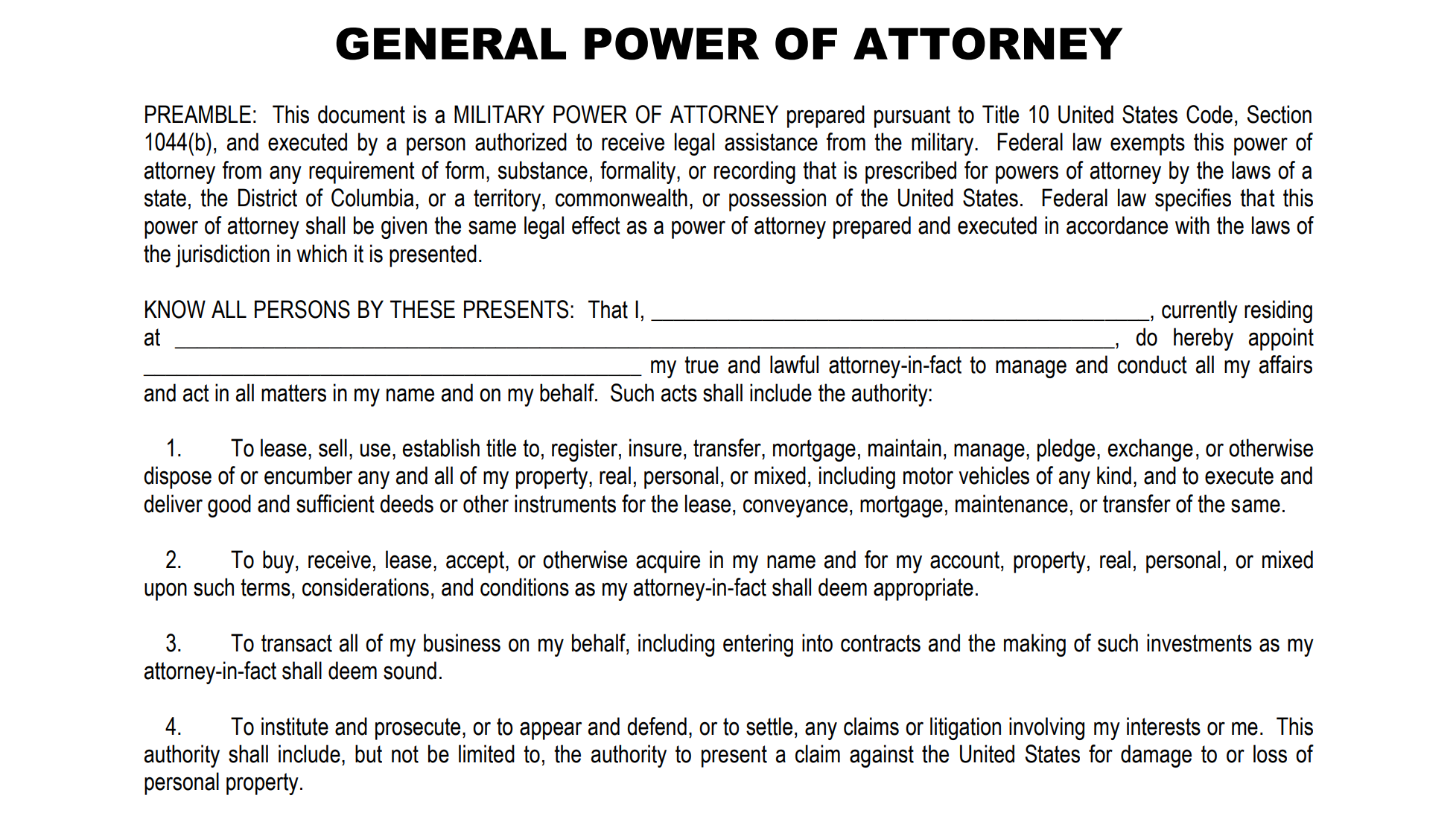
The military provides legal services offices for all branches that can prepare a power of attorney for service members. A list of these offices is available here. If you’re stationed overseas and can’t find your installation listed, call Military OneSource at 800-342-9647 for help locating your legal assistance office.
Types of Power of Attorney for Service Members
General Power of Attorney (GPOA): Grants broad authority to the designated agent, covering most financial and legal matters.
A (GPOA) grants broad authority to handle financial, legal, and personal matters, except those explicitly excluded in the document. This includes managing investments, banking, contracts, property, government benefits, and taxes. In some states, GPOAs can also create or modify trusts. Granting a GPOA doesn’t remove the individual’s right to make decisions while they remain mentally capable. A GPOA is valid until the specified expiration date, the grantor’s incapacitation, or death. Given the extensive authority it confers, a GPOA should be entrusted only to someone you trust completely.
Special Power of Attorney (SPOA): Limits the agent’s authority to specific tasks, such as selling property, managing accounts, or signing documents.
- A person named in a Specific Power of Attorney has authority over a specific situation as described in the document. It may be authority over business operations, debt collections, or the sale of a home, for example. Specific Power of Attorney documents remain in effect until the date indicated in the document, until the specific transaction is completed, or until the issuer of the power passes away.
Durable Power of Attorney: Remains effective even if the grantor becomes incapacitated, allowing the designated agent to manage financial, legal, or healthcare decisions
- When someone is granted Durable Power of Attorney, they are given authority over another person’s financial affairs if he or she is unable to handle them on their own, either temporarily or permanently. Most people recommend that Durable Power of Attorney documents be written as “springing” power of attorney – so that you can specify what kind of events will make the power of Attorney document active and give authority to the person named. Doctors are hesitant to label anyone as incapacitated or unable to make their own decisions, even when it is obvious, so having a “springing” power of attorney can remedy the situation by indicating specific events.
Springing Power of Attorney: Becomes effective only when a specific event or condition, such as the grantor’s incapacitation, occurs.
When someone is granted Springing Power of Attorney, it becomes effective when the issuer becomes incapacitated (unable to handle their own affairs) or when the person travels outside the country, etc. The events that transfer the power of attorney are specified in the document.
Choose your Power of Attorney and Agent Wisely
A power of attorney gives someone the legal right to act on your behalf. Because of its broad nature, you should grant a power of attorney only when absolutely necessary and, if possible, limit it to specific events or for a set time frame. Before entering into a power of attorney agreement, it is strongly recommended that you visit a military legal services office or consult an attorney for legal advice.
Remember, the military can provide this through its legal services offices. A list of these offices is available here.
Why Military Families Need a Power of Attorney
Service members often face situations where a POA is indispensable, such as:
- During Deployments: To handle financial obligations, childcare decisions, or home maintenance.
- PCS Moves: For managing real estate transactions or signing lease agreements.
- Unexpected Emergencies: When urgent decisions need to be made in the service member’s absence.
How to Obtain a Military Power of Attorney
The process for obtaining a military POA is straightforward:
- Visit the Legal Assistance Office: Every military installation has a Legal Assistance Office that provides free legal services to service members.
- Fill Out the Appropriate Form: Your legal office can assist you in completing the appropriate military power of attorney form for your needs.
- Notarization: Military POAs are notarized free of charge and comply with federal law (10 U.S.C. § 1044b), making them valid across all states.
Military Power of Attorney for Spouses
For military spouses, having a POA can be crucial in managing family responsibilities. With a POA, spouses can:
- Access joint bank accounts.
- Handle insurance claims.
- Enroll children in school or medical programs.
- Manage household or personal financial matters.
Key Considerations When Creating a Military Power of Attorney
- Select a Trusted Agent: Choose someone reliable and capable of handling the responsibilities you assign.
- Understand the Scope: Clearly define the authority you are granting to avoid misunderstandings or misuse.
- Set an Expiration Date: Most military POAs include an expiration date, ensuring the agent’s authority isn’t indefinite.
- Keep Copies Accessible: Provide copies to relevant institutions, such as banks or healthcare providers, and keep one for yourself.
Frequently Asked Questions
1. Is a military POA different from a regular POA?
Yes, military POAs are governed by federal law and are designed to meet the unique needs of service members and their families. They are accepted across all 50 states and typically notarized at no cost through military legal services.
2. Can a military POA be revoked?
Yes, you can revoke a POA at any time by notifying the agent in writing and destroying all copies of the document. Inform any institutions where the POA has been filed.
3. What happens if I don’t have a POA during deployment?
Without a POA, your family members or trusted individuals may face delays or legal hurdles in handling important matters on your behalf.
*Note: This article is for general informational purposes only and should not be considered legal advice. Please consult with a professional legal representative before choosing which Power of Attorney is right for your situation. Your base legal department is a great place to start.