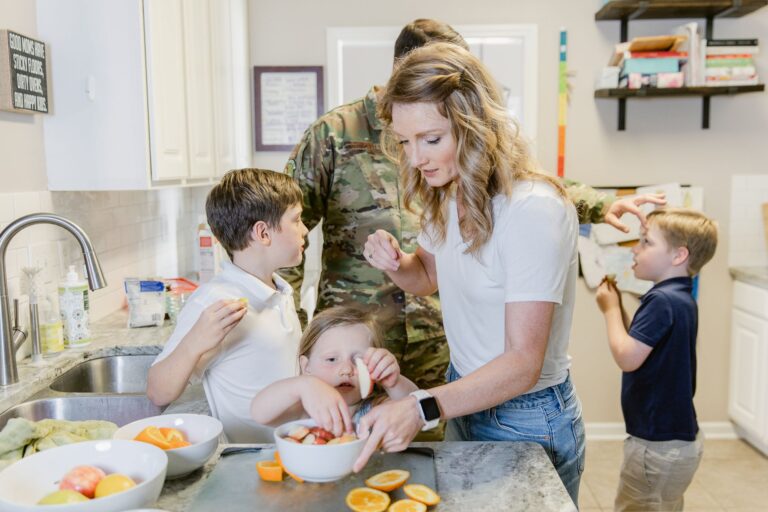
Solving the Military Child Care Puzzle: Kayla Corbitt Podcast
Military spouse and Operation Child Care Project founder Kayla Corbitt joins The Military Wallet Podcast to discuss military child care challenges, long waitlists, deployment realities, summer care costs, and why child care has become a military readiness issue.


Why trust The Military Wallet? We’re a veteran-founded resource that has helped millions make strong financial decisions.
Advertiser Disclosure: The Military Wallet and Three Creeks Media, LLC, its parent and affiliate companies, may receive compensation through advertising placements on The Military Wallet. For any rankings or lists on this site, The Military Wallet may receive compensation from the companies being ranked; however, this compensation does not affect how, where, and in what order products and companies appear in the rankings and lists. If a ranking or list has a company noted to be a “partner,” the indicated company is a corporate affiliate of The Military Wallet. No tables, rankings, or lists are fully comprehensive and do not include all companies or available products.
The Military Wallet and Three Creeks Media have partnered with CardRatings for our coverage of credit card products. The Military Wallet and CardRatings may receive a commission from card issuers. You can read more about our card rating methodology here.
Opinions, reviews, analyses & recommendations are the author’s alone and have not been reviewed, endorsed, or approved by any of these entities. For more information, please see our Advertising Policy.
American Express is an advertiser on The Military Wallet. Terms Apply to American Express benefits and offers.
What happens when military readiness collides with the realities of raising children?
In a recent episode of The Military Wallet Podcast, host Ryan Guina sat down with Kayla Corbitt to unpack one of the military community’s most persistent — and increasingly visible — challenges: child care.
The conversation goes far beyond long waitlists at base Child Development Centers or applying for fee assistance programs. Instead, it exposes how military families are often forced to stitch together multiple forms of care while navigating deployments, shift work, PCS moves, unpredictable schedules, and a complicated web of military and civilian programs.
For many military parents, especially younger families or those new to service life, child care is not just a household issue. It is a readiness issue, a retention issue, and increasingly, a mental health issue.
Corbitt, an Army spouse and founder of Operation Child Care Project, explains that many families enter the military assuming child care support is straightforward, only to discover a system filled with policies, reimbursement models, priority categories, accreditation requirements, and logistical barriers.
“Child care needs to be viewed more as a menu and less as a ‘this or that,’” said Corbitt during the episode. “Very rarely have we seen any family leverage just one form [of care].”
That patchwork reality shapes nearly every aspect of the discussion.
The Myth of “Military Child Care”

One of the biggest misconceptions discussed in the episode is the idea that military families simply receive guaranteed, affordable child care.
Instead, military families often face:
- Long waitlists for on-base care
- Limited operating hours that do not align with military schedules
- High upfront costs for civilian providers
- Reimbursement delays
- Staffing shortages
- Geographic barriers during PCS moves
- Limited overnight or weekend options
The discussion highlights how the military’s traditional child care infrastructure was largely built around standard daytime schedules, not the realities of aircraft maintenance shifts, overnight duty, field exercises, deployments, or military spouses who also work full-time.
Corbitt notes that many Child Development Centers (CDCs) are now closing as early as 5 p.m., even as military operations continue around the clock. For families working irregular duty hours, a standard daycare model can’t meet the need, putting the burden of finding care that can keep up on families, not the institution that created the care gap.
The episode also explores the differences between military-operated and civilian-operated care, including:
- CDCs (Child Development Centers)
- FCC homes (Family Child Care providers)
- Military Child Care in Your Neighborhood (MCCYN)
- Child Care in Your Home (CCH)
- State preschool and universal pre-K programs
- Head Start
- Trusted caregivers, including friends, neighbors, and family members
Corbitt repeatedly emphasizes that no single option works for every family, and many families rely on two or three systems simultaneously.
Why Military Families Struggle to Navigate the System
A recurring theme throughout the episode is confusion.
Even families with years of military experience often struggle to understand how child care programs actually work.
Guina, who served on active duty before becoming a military spouse himself, admitted that despite years in uniform, he still found many family programs difficult to navigate.
Corbitt’s own experience launching Operation Child Care Project came after years of researching military family policies, only to discover that the system still failed her once she became a parent herself.
That disconnect, she argues, reveals a larger issue: military child care programs are often designed in isolated “silos” that do not easily work together.
The episode breaks down how reimbursement programs like MCCYN function and why they can create major financial strain for military families. While MCCYN can offset significant child care costs, families often must pay thousands of dollars upfront while waiting for reimbursement approval.
For junior enlisted families already balancing housing costs, PCS expenses, or deployment-related financial stress, those upfront costs can become impossible barriers.
Listeners also hear practical discussions about:
- How to evaluate providers
- What licensing reports actually mean
- Why military child care inspections differ from civilian licensing
- How to identify red flags in reviews
- Why touring facilities matters more than online ratings alone
The discussion acknowledges the emotional difficulty many parents face when leaving children in someone else’s care for the first time, a reality for military families who move every two to three years.
Building a “Care Team” Before You Need One
One of the most compelling parts of the conversation focuses on community.
“Your goal here is to have multiple people that you could rely on,” said Corbitt. “Over 80% of children in the US are cared for by trusted caregivers: friends, family, neighbors.”
Corbitt argues that military families cannot afford to remain isolated, especially during deployments, TDYs, or emergencies.
Her advice is surprisingly practical: start talking to people before you desperately need help.
That includes:
- Front desk staff at schools and daycare centers
- Other parents during pickup and drop-off
- Family readiness groups
- Unit spouse networks
- Neighbors
- Teachers
- School secretaries
The episode reframes child care less as a transactional service and more as a support ecosystem.
For military spouses facing solo parenting during deployments, Corbitt recommends what she calls “safety planning”. She recommends proactively identifying emergency contacts, backup caregivers, temporary support options, and community resources before crises occur.
The conversation also touches on the emotional reality many military spouses experience: feeling uncomfortable asking for help.
Corbitt shares a surprisingly simple networking strategy that has apparently worked “100% of the time” for parents trying to build community connections through their children’s friendships — a moment in the podcast that balances humor with genuine insight into military family isolation.
The Hidden Cost of Summer and School-Age Care
Another major topic in the episode is school-age care, particularly summer programs.
Corbitt describes summer child care as “a mortgage and a half,” noting that many military families underestimate just how expensive school breaks become once children age out of traditional daycare programs.
The discussion highlights several lesser-known resources military families may not realize they can use, including:
- Dependent Care Flexible Spending Accounts (FSAs)
- Universal pre-K programs
- State preschool subsidies
- Head Start
- County-level child care assistance programs
- Special education and IEP-related preschool services
One key takeaway: Many military families mistakenly assume they cannot combine military and civilian assistance programs.
Corbitt stresses that families can often “stack” multiple support systems together because the funding comes from different sources.
A Growing Visibility Problem & a Growing Movement
Toward the end of the episode, the conversation broadens into a larger discussion about military readiness and public policy.
Corbitt argues that military child care challenges are no longer viewed solely as “young enlisted family problems.” Increasingly, officers and older first-time parents are also encountering the same barriers.
That shift, she says, has made the issue harder to ignore.
The episode also explores emerging efforts to rethink child care as community infrastructure rather than a private family burden.
Corbitt points to initiatives in places like Colorado Springs where developers, policymakers, and community organizations are discussing how housing projects and local planning could integrate child care solutions directly into neighborhoods.
For military families accustomed to hearing that resilience means “figuring it out,” the conversation offers something different: acknowledgment that the system itself is struggling to meet modern military family realities.
Resources Mentioned in the Episode
Military families looking for support or additional information can explore:
- Operation Child Care Project
- MilitaryChildCare.com
- Military OneSource Child Care Resources
- Head Start Locator
- Child Care Aware of America Military Programs
For families navigating PCS transitions, deployments, or long waitlists, the episode serves as both validation and practical guidance, while also raising larger questions about what military family support should actually look like in the future.