Does Food Insecurity Exist in the Military?
Does food insecurity exist in the military? What is the benefits cliff? And how does financial stress impact military families?

Why trust The Military Wallet? We’re a veteran-founded resource that has helped millions make strong financial decisions.
Advertiser Disclosure: The Military Wallet and Three Creeks Media, LLC, its parent and affiliate companies, may receive compensation through advertising placements on The Military Wallet. For any rankings or lists on this site, The Military Wallet may receive compensation from the companies being ranked; however, this compensation does not affect how, where, and in what order products and companies appear in the rankings and lists. If a ranking or list has a company noted to be a “partner,” the indicated company is a corporate affiliate of The Military Wallet. No tables, rankings, or lists are fully comprehensive and do not include all companies or available products.
The Military Wallet and Three Creeks Media have partnered with CardRatings for our coverage of credit card products. The Military Wallet and CardRatings may receive a commission from card issuers. You can read more about our card rating methodology here.
Opinions, reviews, analyses & recommendations are the author’s alone and have not been reviewed, endorsed, or approved by any of these entities. For more information, please see our Advertising Policy.
American Express is an advertiser on The Military Wallet. Terms Apply to American Express benefits and offers.
Military families are often viewed through the lens of stability: guaranteed paychecks, housing allowances, healthcare, and support systems designed to care for those who serve. But beneath that perception lies a fairly well-defined problem that many families are still reluctant to talk about publicly: food insecurity.
Does Food Insecurity Exist in the Military?
The short answer is yes.
And data reveals a very uncomfortable truth: food insecurity in the military community is far more common than many people realize.
| Year | Rate of Military Families Facing Food Insecurity |
| 2017 | 1 in ~7 families |
| 2019 | 1 in 8 families |
| 2021 | 1 in 5 families |
| 2022 | 1 in 6 families |
| 2023 | 1 in 5 families |
Source: Military Family Advisory Network
“It Could Happen to Anybody”
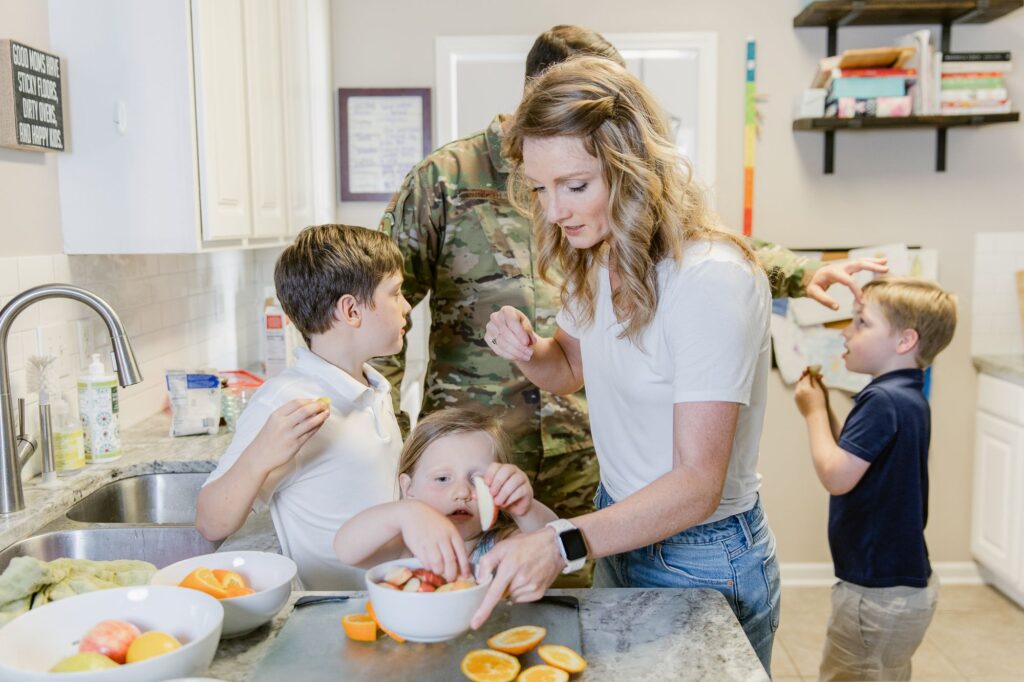
Heather Campbell describes herself as an “accidental advocate.” Her advocacy work began not through politics or policy, but through lived experience.
Despite being an officer family with three college degrees between them, Campbell and her husband struggled financially while stationed at Eielson Air Force Base near Fairbanks, Alaska.
The family faced mounting student loan payments, limited child care options, spouse unemployment, and the unique financial pressures that often accompany military life. They narrowly missed qualifying for assistance programs like WIC by just $67 per month.
That gap left them in what many advocates call the “benefits cliff”, earning slightly too much to qualify for assistance, but not enough to comfortably absorb rising costs.
“We never went without,” Campbell explained during the episode, “but it was a constant mental load.” That mental load became one of the podcast’s most important themes.
Many military families do not qualify for SNAP benefits because eligibility is based on household income, and military compensation includes allowances like Basic Allowance for Housing (BAH) and Basic Allowance for Subsistence (BAS). As a result, families may appear financially stable on paper while still struggling with high housing costs, child care expenses, debt, spouse unemployment, and the financial strain of frequent PCS moves.
What Is Food Insecurity?
One of the biggest misconceptions is the definition of food insecurity itself.
Food insecurity is not simply starvation or hunger. According to the USDA, food insecurity refers to “limited or uncertain access to adequate food.”
For many military families, food insecurity looks like:
- Skipping meals so children can eat
- Stressing over grocery costs before payday
- Relying on credit cards to cover essentials
- Constantly calculating whether an unexpected expense will derail the month’s budget
- Choosing cheaper, less nutritious foods because they stretch farther
Campbell noted that military food insecurity often exists quietly in middle-income military households, especially among E4 to E7 families balancing children, moves, spouse unemployment, and rising costs.
This challenges the stereotype that food insecurity only affects junior enlisted troops or unemployed civilians.
While planning for the unexpected is routine in the military, the community has to do so again and again. While many can mentally plan, it can be harder to recover after unexpected financial losses.
Why Military Families Are Especially Vulnerable
And military families may face unique financial pressures compared to many civilian households.
Frequent PCS moves, unpredictable employment for spouses, child care shortages, and rising housing costs create layers of instability that can quickly overwhelm even financially responsible families.
The military’s Basic Allowance for Subsistence (BAS) is calculated only to feed the servicemember, not their spouse or children. Meanwhile, according to the nonprofit Military Officers Association of America, housing allowances often fail to match actual housing costs in competitive markets.
What does that mean? Even financially savvy families can struggle when several “normal” emergencies happen at once:
- Car repairs
- Insurance deductibles
- Damaged household goods during a move
- New utility deposits
- Home maintenance costs
- Temporary housing gaps during PCS transitions
This may result in many military families may feel they are doing everything “right” and still struggling to stay afloat.
The Basic Needs Allowance (BNA) is a supplemental payment created to help active-duty military families whose household income falls below a federally set threshold, acknowledging that some servicemembers still struggle to afford essentials like food despite receiving military pay and allowances. Its existence reflects growing recognition that food insecurity in the military is often tied to systemic issues such as high housing costs, spouse unemployment, child care expenses, and frequent moves — not simply poor budgeting.
The Emotional Toll No One Talks About
But there is also an emotional and psychological toll to this type of financial stress.
In a recent episode of The Military Wallet Podcast, Campbell openly shared how isolation, financial pressure, parenting stress, and constant uncertainty contributed to feelings of depression and hopelessness during one particularly difficult season of life.
Her honesty highlighted another important issue: military families often hesitate to ask for help.
In military culture, self-reliance and resilience are deeply valued. Many servicemembers and spouses feel pressure to “handle it” privately, especially those in leadership positions.
Many families may think:
- Someone else needs help more
- Asking for help reflects personal failure
- Financial struggles could hurt careers or reputations
- Their situation “isn’t bad enough”
The result is that many families suffer silently.
While food insecurity resources are vital, so are resources to support the mental health impacts of financial uncertainty. Resources like the national 988 crisis line, which provides immediate mental health support via call or text, are one way military families can get help.
Grocery Shopping Strategies and Budgeting Tips
It is important for military families to simplify their approach to nutrition and ignore the unrealistic messaging often promoted by diet culture and social media influencers.
It is vital that families build realistic, sustainable habits:
- Start meal planning with food already in the home
- Build meals around weekly grocery sales
- Use frozen and canned produce strategically
- Stretch proteins with beans, mushrooms, or lentils
- Reuse leftovers creatively
- Shop generic brands when possible
- Match meal complexity to weekly schedules
Look for ways to “extend” expensive proteins by mixing ground beef with black beans or mushrooms and adding vegetables and eggs to pantry staples like ramen.
There are many ways military families can make due with what they have, while also leveraging available resources. These strategies should be used to support military families, while advocates like Campbell and others seek policy improvements where necessary.
Food Insurity Resources
National Resources
- 988 Suicide & Crisis Lifeline
- Feeding America Food Bank Locator
- WIC Program Information
- SNAP Benefits Information
Military-Specific Resources
Why This Conversation Matters
Military food insecurity is often invisible because the families experiencing it frequently appear stable from the outside.
But financial strain can affect anyone, especially in a lifestyle built around frequent moves, disrupted spouse careers, and unpredictable expenses.
Gone are the days when asking for help in the military community is seen as a weakness. Food insecurity not a personal failure, but an issue that deserves visibility, empathy, and practical support.
For military families quietly carrying the stress of stretching groceries, juggling bills, or wondering how they will make it through the next PCS season, you are not alone.