Understanding Reserve and Guard Good Years & Points
Members of the Guard and Reserves earn Retirement points for their service. Learn how to accrue points and become eligible for "Good Years" of service to qualify for retirement benefits.


Why trust The Military Wallet? We’re a veteran-founded resource that has helped millions make strong financial decisions.
Advertiser Disclosure: The Military Wallet and Three Creeks Media, LLC, its parent and affiliate companies, may receive compensation through advertising placements on The Military Wallet. For any rankings or lists on this site, The Military Wallet may receive compensation from the companies being ranked; however, this compensation does not affect how, where, and in what order products and companies appear in the rankings and lists. If a ranking or list has a company noted to be a “partner,” the indicated company is a corporate affiliate of The Military Wallet. No tables, rankings, or lists are fully comprehensive and do not include all companies or available products.
The Military Wallet and Three Creeks Media have partnered with CardRatings for our coverage of credit card products. The Military Wallet and CardRatings may receive a commission from card issuers. You can read more about our card rating methodology here.
Opinions, reviews, analyses & recommendations are the author’s alone and have not been reviewed, endorsed, or approved by any of these entities. For more information, please see our Advertising Policy.
American Express is an advertiser on The Military Wallet. Terms Apply to American Express benefits and offers.
While members of the Reserve Component share most of the same retirement benefits as active duty, such as healthcare and pension plans, their eligibility requirements differ. Unlike active duty servicemembers who build up retirement pay based on the number of years served, Guard and Reserve members are awarded points based on the types of service they perform.
Understanding this point system as well as how to earn these points is essential for understanding how and when you will be eligible for National Guard and Reserves retirement benefits and how much you will earn in retirement.
What is a Good Year in the National Guard or Reserve?
As Guard and Reserve members accrue retirement points, their points accumulate as Good Years, or years of service eligible to be counted towards retirement.
In general, members of the National Guard or Reserves need 20 Good Years of service in order to be eligible to retire. This can be any combination of qualified years of service in the National Guard, Army Reserves or active duty.
Once you’ve earned your 20 Good Years, a Reserve pension usually doesn’t begin until age 60 unless the servicemember qualifies for early retirement based on their active duty time or activations. Generally, servicemembers who have completed 20 years but are not old enough to retire with full benefits are referred to as “gray area” retirees.
Some other exceptions exist, such as those who receive a medical retirement or those who are eligible for retirement under the Temporary Early Retirement Authority (TERA).
However, generally, 20 Good Years is the standard.
How to Earn Retirement Points
In order to qualify for a Good Year, Guard and Reserve members must earn a combination of points totaling at least 50 retirement points each anniversary year. While your total points build up over the entire duration of your military career, the 50 needed to qualify for a Good Year resets yearly on your AYE, or anniversary year end date.
These anniversary year end dates occur when a reserve member enters active status or active service, which is typically either your first day in the reserves or the date you were commissioned. This date may change if the servicemember has a break in service.
There are two categories of points that can be earned towards a Good Year: membership and service. On each respective branches’ retirement record system, the service point categories are further broken down into active duty, inactive duty, and correspondence.
Earning Membership Points

Guard and Reserve members automatically earn 15 points each year they participate in their respective parent services, often listed as membership points. This includes service in both the regular Reserves and the Individual Ready Reserve (IRR).
Regular Reserve members have probably heard the phrase “One Weekend a Month, Two Weeks a Year” from their recruiter or retention officer. This phrase refers to Regular Reserve members’ duty to attend one drill weekend a month and a two-week training period per year. If you complete your regular Reserve minimum service requirements, you’ll earn 15 points.
IRR members, on the other hand, aren’t inherently subject to additional duty requirements – the military simply keeps their information on file if they need to do a recall or mobilization. Unlike the Active Reserve Component, IRR members earn 15 Participation points per year, even if they don’t do anything else.
Earning 15 points is a good start for Guard and Reserve members, but in order to qualify for a Good Year, they’ll need to complete additional service to reach 50 points.
Earning Service Points
Guard and Reserve members earn additional points through their annual service in their respective parent services. This service is broken down into Active Service and Inactive Duty Training.
Active Service
Active Service includes active duty, active duty for training, and annual training. Active duty and active duty for training days are when the Reserve member is called to active duty, including mobilizing, deploying, training, etc. Annual training days are the yearly two-week training requirement, or the “two weeks a year.”
Servicemembers earn one retirement point per day while in these statuses. Additional retirement points cannot be awarded for other activities while in active duty status.
In addition to receiving retirement points, all Active Service requirements are paid statuses.
Transfer into the IMA
The Individual Mobilization Augmentation (IMA) program is part of the Reserves. IMA members earn the normal 15 Annual Participation Points despite not serving the standard weekend drill schedule. Instead, IMA members fill in to “augment” when and where they are needed.
The benefit of transferring into the IMA is the ability to batch your service days and serve your entire year’s obligation within one or two periods instead of serving throughout the year.
Many IMA members can pick up more duty days if they are willing to volunteer and put in the time. Also, some IMA duties are located in prime overseas duty locations – which makes this a fun way to travel on the government’s dime and mix business with pleasure.
Not all career fields or ranks are eligible for IMA duty, so check with your parent human resources agency for availability and more information.
Inactive Duty Training
Members on Inactive Duty Training can earn different amounts of points depending on the type of service they are performing. Common Inactive Service Duty includes weekend drills, performing in the Honor Guard for Funeral Honors Duty, and inactive or additional training.
Regular Reserve members can be paid for some Inactive Duty Service, including drills, whereas IRR members cannot. Serving in the Honor Guard is often an unpaid duty. Correspondence courses may be paid or unpaid, depending on the course and the availability of unit funds.
Multiple Unit Training Assemblies (MUTAs) and Drill Weekends
Multiple Unit Training Assemblies (MUTAs), known more simply as drills, are a large component of how Reserve Component members earn points through Inactive Duty Training.
Typically, four drill periods take place one weekend per month. During a typical drill weekend, there are two drills these weekends: morning drills and afternoon drills. Each drill lasts 4 hours in total which converts to 1 inactive duty point. These four drills in total earn you 4 inactive duty points.
In addition to retirement points, regular Reserve members receive an equivalent of 1 day’s pay for each drill (based on 1/30th of the monthly base pay for their pay grade and time in service). Both regular Reserve and IRR members earn 1 Point per drill (not to exceed 2 points per calendar day).
Drilling for Points
As previously mentioned, IRR can earn points towards retirement, but unlike regular Reserve members, they’re not eligible to be paid for their Inactive Duty Training. However, to reach the minimum of 50 points needed to qualify for a Good Year, they may still drill for points only. Oftentimes, you will need to submit paperwork and gain approval from the appropriate authority within your parent service, so make sure to do your research before showing up for drill.
How many MUTAs for a Good Year?
Assuming you earn all four points every drill weekend, you would need to complete at least nine drill weekends to qualify for a good year:
4 Inactive Duty Training points X 9 Drill Weekends = 36 points + 15 Membership points = 51 points
However, as you are required to complete at least 48 MUTAs (12 weekends) a year, acquiring these points should be no problem as long as you stay committed to completing your regular Reserve requirements.
Serving in the Honor Guard for Military Funerals
Honor Guard members earn 1 inactive duty point each day they participate in military funeral duties. This is typically unpaid duty (unless you are on active duty orders). But, it can be a good way to serve while earning additional points. It’s also one of the most humbling ways we can honor our fellow servicemembers one last time.
Correspondence Courses
Some correspondence courses, but not all, count toward retirement points. Most military branches will award credit for certain Professional Military Education (PME) courses required for promotion or career advancement. Speak with your Personnel or Education & Training sections to see if they have a list of approved courses for point credit.
Retirement Points Earned Per Year
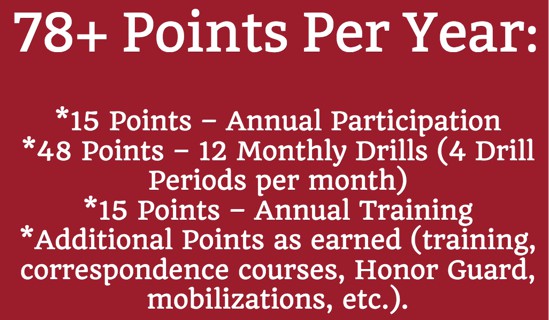
An average year in the Guard or Reserves should be worth approximately 78 retirement points. This is broken down as follows:
- 15 points – Annual Participation
- 48 points – 12 monthly drills (4 drill periods per month to choose from)
- 15 points – Annual Training (this can vary based on your unit, only for Regular Reserve)
- Additional points as earned (training, correspondence courses, Honor Guard, mobilizations, etc.).
Note: Average varies per servicemember. The math above applies to the standard “one weekend a month, two weeks a year” for an average year in the Guard or Reserves. However, the average year may not apply to everyone. It’s very common to earn more or less points than this estimate, depending on your specific situation and the needs of your unit.
Retirement Point Limits
The maximum number of retirement points a servicemember could earn in any given year is 365 (366 in leap years). This corresponds to serving every day on active duty (or an equivalent number of service points).
Additionally, by law, there is a cap on the number of Inactive Duty Training points that can be accrued for retirement in a given year.
- Reserve year ends on or after Oct. 30, 2007: max of 130 Inactive Duty Training points
- Reserve year ends on or after Oct. 29, 2000: max of 90 Inactive Duty Training points
Note: You cannot double dip on retirement points and do correspondence courses or other services to earn more than 365 points in a given year.
These limits apply to all branches of the military.
Tracking Retirement Points
Your parent service should maintain all retirement points and can be accessed in your service’s personnel website. It’s a good idea to review these points regularly to ensure your service is correctly credited. It’s highly recommended to review your points if you:
- Have a break in service
- Are mobilized or called to active duty
- Complete any correspondence or unpaid duty that results in earned retirement points.
It’s also a good idea to print and maintain copies of your Point Credit Summaries each year to have a physical record.
If you notice your paperwork needs a correction, contact your parent service’s retirement team and submit the appropriate paperwork to rectify your points as soon as possible.
How to Get Your Points Statement
| Where to Get Point Statements by Branch | |
| Army National Guard | Go to IPPS-A Landing Page (army.mil). Select “HR Professional”, then select “View Retirement Points”. |
| Air Force Reserve and Air National Guard | Go to https://www.my.af.mil. Navigate to the Virtual Military Personnel Flight (vMPF), select “Self-Service Actions”, select “Personal Data” and click “ANG/USAFR Point Credit Summary Inquiry (PCFARS).” |
| Army Reserve | Review your “Chronicle Retirement Point Statement DA 5016” at www.hrc.army.mil. Select the “My Record” tab to review. Note: CAC card required. |
| Marine Corps Reserve | Review your “Career Retirement Credit Report” at https://mol.tfs.usmc.mil/mol |
| Navy Reserve | Review your “Annual Retirement Point Record” (ARPR) at https://www.bol.navy.mil/ARPR/ |
| Coast Guard Reserve | Go to https://portal.direct-access.us. Click on “My Reserve Points Statement” under the “Employee View” menu. |
It Takes 20 Good Years to Qualify for a Guard/Reserve Retirement
Based on the information above, you should have a good idea of what it takes to qualify for a Reserve retirement. 20 Good Years may sound like a long time, but if you follow the guidelines outlined above, you should have no problem qualifying for your full military retirement plan.