Beyond the Battlefield Podcast Episode: Jennifer Barnhill on the Hidden Stories of Military Families
In this Military Wallet Podcast episode, journalist Jennifer Barnhill explores hidden military family stories, spouse employment barriers, housing issues, and the gap between policy and lived experience.

Why trust The Military Wallet? We’re a veteran-founded resource that has helped millions make strong financial decisions.
Advertiser Disclosure: The Military Wallet and Three Creeks Media, LLC, its parent and affiliate companies, may receive compensation through advertising placements on The Military Wallet. For any rankings or lists on this site, The Military Wallet may receive compensation from the companies being ranked; however, this compensation does not affect how, where, and in what order products and companies appear in the rankings and lists. If a ranking or list has a company noted to be a “partner,” the indicated company is a corporate affiliate of The Military Wallet. No tables, rankings, or lists are fully comprehensive and do not include all companies or available products.
The Military Wallet and Three Creeks Media have partnered with CardRatings for our coverage of credit card products. The Military Wallet and CardRatings may receive a commission from card issuers. You can read more about our card rating methodology here.
Opinions, reviews, analyses & recommendations are the author’s alone and have not been reviewed, endorsed, or approved by any of these entities. For more information, please see our Advertising Policy.
American Express is an advertiser on The Military Wallet. Terms Apply to American Express benefits and offers.
What happens after the patriotic slogans fade away? After the deployment ceremonies, homecomings, and social media tributes? In a recent episode of the Military Wallet Podcast, journalist, researcher, author, and The Military Wallet Editor, Jennifer Barnhill, joined host Ryan Guina for a deeply personal and eye-opening conversation about the untold realities of military family life.
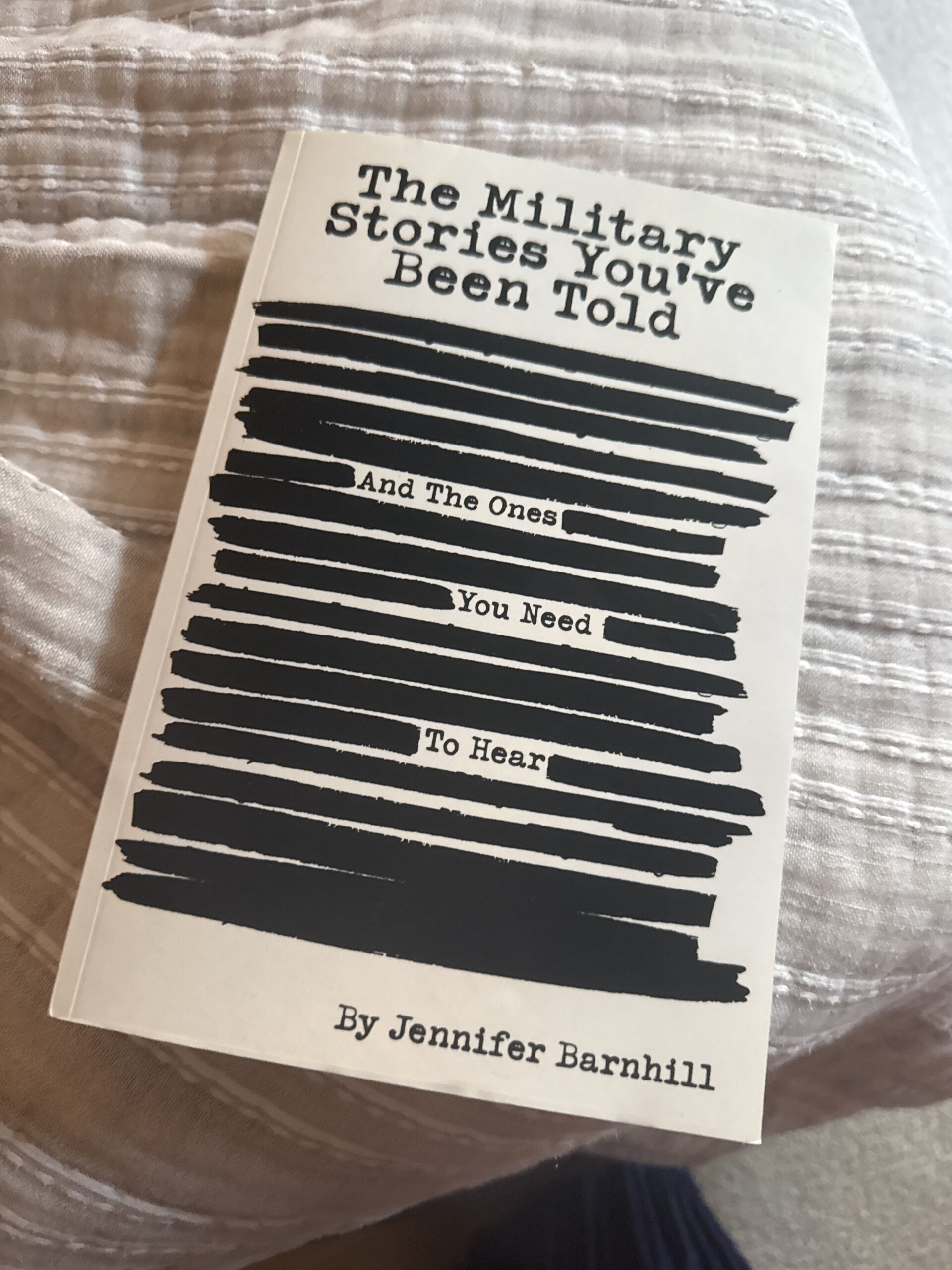
Barnhill’s new book, The Military Stories You’ve Been Told and the Ones You Need to Hear, challenges many of the narratives Americans have long accepted about military spouses. It examines their sacrifice, volunteerism, and support systems. The book draws upon her years of journalism, public policy research, and lived experience as a Navy spouse. The conversation peels back the layers of official policy to reveal the complicated realities military families navigate every day.
“There is always more to the story,” Barnhill shared with TMW. “Just because you’re not necessarily hearing from family members in a loud way doesn’t mean that they are not affected.”
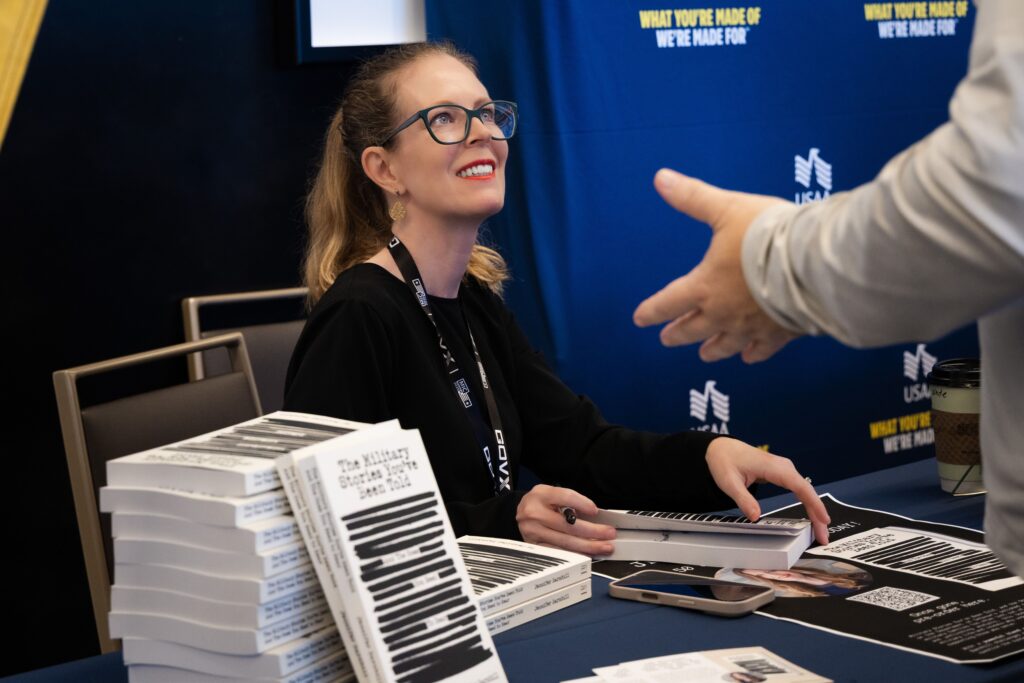
Photo credit: Trish Alegre-Smith
For listeners unfamiliar with the hidden pressures placed on military spouses, the episode serves as both an introduction and a wake-up call. For military families themselves, it may feel like they’re hearing someone describe their lives.
The “Official Story” vs. Real Life
One of the central themes of the conversation is the disconnect between military policy and lived experience. Barnhill describes how military families often operate within two systems simultaneously: the official rules written in policy manuals and the unofficial expectations that quietly shape daily life.
Military spouses, she explains, are often expected to support morale through organizing events, mentoring younger spouses, and contributing to the military community in ways that are technically voluntary but culturally expected. These expectations become even more pronounced as service members rise in rank.
What makes the conversation especially compelling is Barnhill’s historical perspective. She discusses how these unofficial norms are communicated through military spouse guidebooks. These books, dating back to the 1940s, are still being updated today. While the language has changed over the decades, some expectations remain remarkably persistent.
Listeners also learn about a little-known chapter in military history. Until 1988, spouse participation could directly affect a service member’s performance evaluation in some branches. The policy officially changed after Air Force spouses challenged the practice, but Barnhill argues the cultural expectations never fully disappeared.
The Military Spouse Employment Crisis
Another major topic explored in the episode is military spouse employment. This issue continues to affect readiness, retention, and financial stability across the force.
Frequent PCS moves, inconsistent licensing reciprocity between states, overseas SOFA agreement complications, resume gaps, and underemployment all contribute to what Barnhill calls a “wicked problem” — one without a simple solution.
The statistics discussed during the interview are striking. While military spouse unemployment numbers are often cited at around 20%, Barnhill explains that those figures only account for spouses actively seeking work. Roughly 30% of working-age military spouses are categorized as “out of the workforce” entirely.
The distinction matters.
Many spouses stop searching not because they lack ambition, but because the structural barriers become overwhelming. Barnhill highlights research from the Institute for Veterans and Military Families showing that higher education and advanced credentials do not necessarily protect spouses from underemployment. In some cases, the more specialized a spouse becomes, the harder it is to maintain career continuity through repeated relocations.
She also highlighted how perception has played a role in how practitioners approach offering solutions.
“It’s a spouse’s choice to volunteer. It’s their choice to be out of the workforce. It’s a choice that they make. However, when we look at choices, we have to look at the conditions of those choices.” Barnhill calls this misalignment the “myth of choice.” She says the choices made by spouses are seen as singular choices, when in reality, many feel as though they are left without a choice.
Because spouses move every two to three years, creating bouts of unemployment that leave their resumes like Swiss cheese, many are underemployed. They can’t find affordable child care. If they are offered jobs, some have to make the decision to pay to work because child care costs are higher than their income, or break even, despite the added stress on the family schedule.
Barnhill shares that many of these choices are made to benefit the military family unit, but are borne by the spouse themselves. This leaves many without vested savings accounts, making retirement feel out of reach.
Housing, Advocacy, and Accountability
The conversation broadens beyond employment into larger questions of accountability within the military system.
Barnhill and Guina discuss privatized military housing, mold exposure, and the creation of the Military Tenant Bill of Rights following widespread public pressure from military families. But Barnhill emphasizes that when the military creates a policy to solve a problem, it is only the beginning. Her reporting has highlighted that policies must be revisited, evaluated, and enforced to determine whether they are truly solving the problems they were designed to address.
That theme — promises versus outcomes — runs throughout the interview.
Listeners interested in military policy, family readiness, or quality-of-life issues will find the discussion particularly valuable because it connects individual stories to systemic challenges. Rather than treating these issues as isolated incidents, Barnhill’s reporting highlights the structural nature of these problems, problems that require sustained attention.
The Human Cost of Bureaucracy
Perhaps the most emotional portion of the episode centers on the story of Theresa Jones, whose husband, Landon Jones, died after his helicopter went into the ocean while secured aboard a ship.
Barnhill explains how Jones later became involved in advocacy surrounding the so-called “Widow’s Tax” — the Survivor Benefit Plan and Dependency and Indemnity Compensation offset that reduced benefits for many surviving military spouses for decades.
The issue became one of the military community’s most significant survivor advocacy fights, with families spending 20 years traveling to Capitol Hill to share deeply personal stories of loss in hopes of legislative change.
The discussion underscores a difficult reality many surviving spouses face. After the casualty notifications, ceremonies, and public condolences end, families are often left to navigate complex bureaucracies largely on their own.
Barnhill argues that military families should not have to repeatedly relive trauma simply to receive the survivor benefits they were promised.
Who Gets to Tell Military Stories?
Toward the end of the episode, Barnhill shares findings from her own analysis of military media representation. In a sample of roughly 150 military-related stories, only six substantially featured family experiences. She also found officers were quoted at dramatically higher rates than enlisted personnel.
The imbalance, she argues, shapes public understanding of military life.
When only certain voices are amplified, entire portions of the community become invisible, including spouses, children, caregivers, surviving families, reservists, and junior enlisted households.
The podcast episode focuses on the thesis of Barnhill’s book: military families are not tangential to military life. They are part of the story.
Why This Conversation Matters
What makes this podcast episode compelling is not simply the policy discussion. It is the way Barnhill combines research with deeply human storytelling. She avoids simplistic narratives and instead invites listeners to examine the military community in all its complexity.
For civilians, the conversation offers a rare glimpse into challenges often hidden behind patriotic imagery. For service members and families, it validates experiences that are frequently minimized or overlooked.
And for policymakers, employers, and military leaders, the episode raises difficult but necessary questions about what genuine support actually looks like.
Listeners interested in military family advocacy, spouse employment, survivor issues, military housing, or veteran policy will find this episode especially worthwhile.
Whether you are part of the military community or simply want to better understand the realities behind military service, this episode makes one thing clear: some of the most important military stories are the ones we rarely hear.