Tax Rules for Employer’s Tuition Assistance
Many employers offer employee tuition assistance. Understand the relevant tax rules for employer's tuition assistance to avoid owing more on taxes.


Why trust The Military Wallet? We’re a veteran-founded resource that has helped millions make strong financial decisions.
Advertiser Disclosure: The Military Wallet and Three Creeks Media, LLC, its parent and affiliate companies, may receive compensation through advertising placements on The Military Wallet. For any rankings or lists on this site, The Military Wallet may receive compensation from the companies being ranked; however, this compensation does not affect how, where, and in what order products and companies appear in the rankings and lists. If a ranking or list has a company noted to be a “partner,” the indicated company is a corporate affiliate of The Military Wallet. No tables, rankings, or lists are fully comprehensive and do not include all companies or available products.
The Military Wallet and Three Creeks Media have partnered with CardRatings for our coverage of credit card products. The Military Wallet and CardRatings may receive a commission from card issuers. You can read more about our card rating methodology here.
Opinions, reviews, analyses & recommendations are the author’s alone and have not been reviewed, endorsed, or approved by any of these entities. For more information, please see our Advertising Policy.
American Express is an advertiser on The Military Wallet. Terms Apply to American Express benefits and offers.
If you’re working a full-time job and want to improve your career prospects, check to see if your employer has a tuition assistance program. Now, let’s say you paid for college through the G.I. Bill, and want to get more eduction or have debt from either grad school, med school, law school, etc. Many employers have policies that either help pay tuition, school expenses, or student loans from a past degree.
The question you may have this time of year is, “is tuition reimbursement taxable?”
Let’s break down tax rules for employer’s tuition assistance programs to help you better understand if your employer’s tuition assistance is tax-free or considered regular income during tax season.
Tax Rules for Employer’s Tuition Assistance
Is tuition reimbursement taxable? Generally, employer tuition assistance programs are tax-deductible up to the IRS limit. That means you don’t have to pay taxes on your benefit unless it exceeds a certain amount.
Through December 31, 2025, the IRS will allow up to $5,520 in tax-free student loan repayments. This deduction expires on that date.
Employer Tuition Assistance Deduction Amount
An annual employee tuition assistance program deduction applies to your education and other family members, such as your kids. If you receive more than the IRS allows, it will be considered taxable wages.
Example: If you earn $50,000 in a calendar year and get an additional $5,250 in tuition assistance or student loan payment assistance, you’ll pay taxes as if you earned $50,000 from your employer in the year rather than the $55,250 you effectively earned.
If the payments total less than $5,250 and qualify as a “fringe benefit”, your employer does not need to include them in your wages on Form W-2.
Note: Payments over the annual IRS limit are typically included as regular compensation in Box 1 of the W-2 form.
Eligible Items for Tuition Assistance Tax Deduction
While you can use tuition assistance plans for several parts of your education, you can’t use them for just anything.
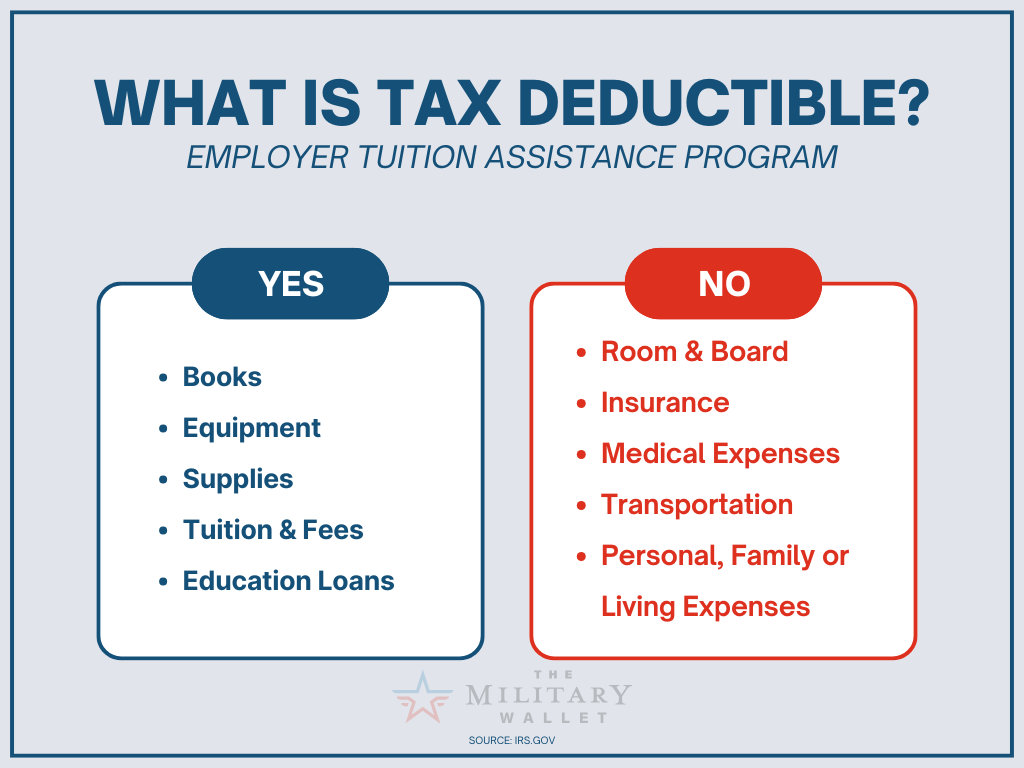
For many employer tuition assistance recipients, the most straightforward use is paying tuition and fees directly to the school. More care is required when using the proceeds for books, equipment, and supplies.
Example: Books only qualify if they’re required for your coursework. You can’t use the funds for a shopping spree at your favorite bookstore. A good way to cover yourself in the event you’re audited is to keep a syllabus or proof that a particular book was needed.
If you’re in school, have already graduated, or attend a private university and the G.I. Bill and Yellow Ribbon Program won’t cover all of your costs, you may still have an opportunity to save on taxes while taking advantage of an employer education benefit.
Note: Starting on January 1, 2026, student loan payments made by your employer are considered taxable income.
You’re also prohibited from using a tax deduction for sports, games, hobbies, or non-credit courses. If you’re part of an intramural sports team, even if it’s through your school, you can’t use tax-advantaged funds for those purposes.
These rules can get complicated in some situations, so if you’re in doubt, you should read IRS tax guides for employer education benefits. Many tax software programs, such as TurboTax and FreeTaxUSA, offer walkthroughs to help you decide what to deduct. When in doubt, it may be best to reach out to a tax professional for clarification. Remember that some tax apps come with free or discounted versions for veterans.
What Qualifies for Tuition Assistance Deductions
We’ve already discussed specific items that qualify for tuition assistance deductions, but you may find you can use employer education benefits for other deductible purposes. Here are some examples of when you may be able to take advantage of an employer’s tuition assistance program and tax deductions.
Your Education
The most straightforward option for employer tuition assistance is paying for your further education. Whether it’s a trade school, certificate, or college degree, many employers are willing to invest in their employees’ educations. Depending on the employer, it may not have to be directly related to your current role.
In some cases, you’ll have to agree to stay with the employer for a minimum time after receiving the financial assistance. Always review the program details closely before applying to avoid any surprises down the road.
Personal note from the author: I was lucky to work at a large employer early in my career that helped pay for my MBA. I received several thousand dollars tax-free toward my education. If I can do it, so can you!
Your Child’s Education
Just as some companies help their employees pay for higher education, many offer assistance with the cost of a child’s education. If you have kids in college or are going soon, check with your HR department or read your employee benefits guide to find out if that’s an option.
Prior Year Education Expenses
Even if you can’t take advantage of an employer education reimbursement this year, you may be able to apply deductions from prior year education expenses. Your tax software or trusted accountant can help you better understand if you have prior-year deductions or credits available this tax year.
You’ll often have to file an amended tax return for the prior year to capture the missed credits or deductions. But that’s often worthwhile if you can get back hundreds or thousands of dollars in prior year taxes.
Common Practices of Employer Tuition Assistance Programs
Employers are finding increasingly innovative ways to entice new hires and keep their current employees happy. Education assistance programs are a great way to help employees while potentially getting more value from better-educated workers.
Each employer offering employer tuition assistance has its own criteria and rules. Understanding common requirements can help you navigate the application process to be sure to look further into certain aspects of the programs:
- Tuition reimbursement: Some employers pay directly to the school, while others reimburse you for tuition, fees, or other eligible costs after you’ve paid for them. Find out if reimbursement is made quarterly or after the end of each academic term when grades are received. If you intend to go to college and take advantage of the employer’s tuition assistance, you’ll want to make sure the cost of tuition is in your budget so you can continue taking classes even if the reimbursement is delayed (or denied).
- Minimum GPA requirements: Many employers offering tuition assistance require that you maintain a minimum grade point average (GPA). Some programs pay more for better academic performance and deny payments for poor performance.
- Major or field of study requirements: Some employers require that the courses you take directly relate to your current position or a potential future position within the company.
- Must remain with the employer: Many employers also stipulate that you must work for the company for a minimum time period after receiving tuition assistance from them. If you leave for any reason, including being fired, you may have to pay back their investment in your education. The employer wants to know if their investment in your education will help them, too. They want to ensure you aren’t going to get your degree and then leave.
It’s important to know these aspects of common employer tuition programs because you don’t want to incorrectly report them on your taxes in the event that you didn’t honor certain requirements.
What You Need to Know
While using your G.I. Bill can greatly reduce the cost of college, the price tag for additional education or certification classes continues to grow. Utitlizing employer tuition assistance programs can be a double benefit:
- Assistance paying for school
- Tax benefit when reporting your income
Both options keep more money in your pocket, so don’t leave that assistance on the table.